
)
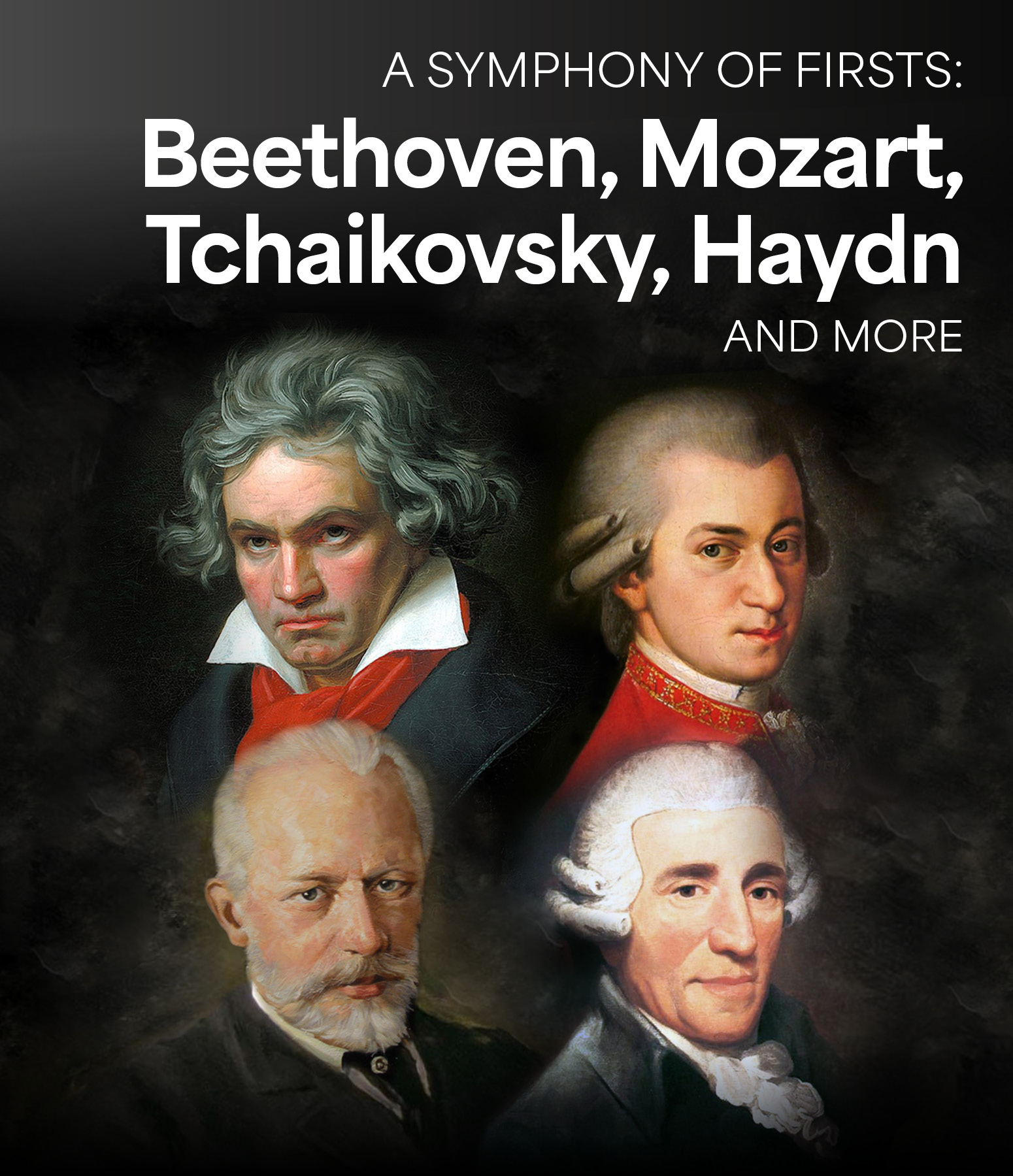
Gulf Coast Symphony at the MACC: A Symphony of Firsts
From $55 | Student Tickets $15
A Journey Through the Evolution of Orchestral Sound
The history of the symphony is the story of human imagination — how composers across centuries expanded the orchestra’s voice to express humor, drama, beauty, and truth.
In A Symphony of Firsts, the Gulf Coast Symphony traces that remarkable evolution, from the elegance of the Classical era to the vibrant color of Romanticism and the bold clarity of the modern age. Each work reveals a moment of artistic transformation: Haydn’s wit engaging his audience, Mozart’s perfect balance of intellect and joy, Beethoven’s fearless innovation, Berlioz’s theatrical color, Debussy’s luminous atmospheres, and Copland’s open, distinctly American sound.
Together, these musical “firsts” illuminate how the symphony became one of humanity’s most expressive and enduring art forms — a reflection of our endless capacity to imagine, to feel, and to create.
Program:
Haydn – Symphony No. 94 “Surprise” (2nd Movement)
First orchestral humor & audience engagement
Haydn turned the genteel symphony into theater — shocking his audience with that famous fortissimo “surprise” chord in the slow movement.
Mozart – Overture to The Magic Flute
First blend of comic opera and serious counterpoint
A perfect Classical overture — clear structure, bright spirit, and a glimpse of Mozart’s genius in balancing intellect and playfulness.
Beethoven – Symphony No. 5 (1st Movement)
First symphony built from a single rhythmic cell
Four notes changed everything. Beethoven transformed a simple motif into an entire dramatic architecture — the essence of symphonic development.
Berlioz – Roman Carnival Overture
First Romantic orchestral showpiece
Color, character, and virtuosity burst from this overture — a concert-hall distillation of Berlioz’s groundbreaking imagination and flair.
Tchaikovsky – Romeo and Juliet Fantasy Overture
First symphonic poem of deep lyricism and passion
A story told in pure sound — from conflict to love and tragic release. Tchaikovsky’s overture transformed Shakespeare into music’s emotional language.
Prokofiev – Symphony No. 1 “Classical” (I. Allegro)
First great neoclassical symphony
Written “as Haydn might have if he’d lived in the 20th century,” Prokofiev’s witty miniature nods to the past while embracing modern harmonic bite.
Debussy – Nocturnes: “Nuages” (Clouds)
First mature orchestral Impressionism
Debussy paints the sky in sound — drifting harmonies and muted colors replace traditional form. A quiet revolution: music as atmosphere, not argument.
Copland – Fanfare for the Common Man
First truly American orchestral sound
Brass and percussion alone — bold, open, democratic. Copland gave voice to everyday heroism with radiant simplicity.
About the Composer
Ludwig Van Beethoven
Ludwig van Beethoven is one of the most widely recognized and admired composers in the history of Western music, and served as an important bridge between the Classical and Baroque era styles he admired and the Romantic style his music would come to personify. Beethoven was born in 1770 into a modest family in the small German provincial town of Bonn, where he would study composition and play the piano and viola until moving to Vienna in his early 20’s where he would live the rest of his life.
Read More ››Hector Berlioz
Read More ››Claude Debussy
Claude Debussy (22 August 1862 – 25 March 1918) was a French composer. He is sometimes seen as the first Impressionist composer, although he vigorously rejected the term. He was among the most influential composers of the late 19th and early 20th centuries. Born to a family of modest means and little cultural involvement, Debussy showed enough musical talent to be admitted at the age of ten to France’s leading music college, the Conservatoire de Paris. He originally studied the piano, but found his vocation in innovative composition, despite the disapproval of the Conservatoire’s conservative professors. He took many years to develop his mature style, and was nearly 40 when he achieved international fame in 1902 with the only opera he completed, Pelléas et Mélisande.
Read More ››Franz Joseph Haydn
Franz Joseph Haydn (March 31, 1732 – May 31, 1809) was an Austrian composer of the Classical period. He was instrumental in the development of chamber music such as the piano trio. His contributions to musical form have earned him the epithets “Father of the Symphony” and “Father of the String Quartet”.
Read More ››Wolfgang Amadeus Mozart
Wolfgang Amadeus Mozart was a prolific and influential composer of the classical era. Born in Salzburg, he showed prodigious ability from his earliest childhood. He composed more than 600 works, and is among the most popular of classical composers. His influence is profound on subsequent Western art music.
Read More ››Sergei Prokofiev
Sergei Prokofiev (23 April 1891 – 5 March 1953) was a Russian and Soviet composer, pianist and conductor. As the creator of acknowledged masterpieces across numerous musical genres, he is regarded as one of the major composers of the 20th century. His works include such widely heard works as the March from The Love for Three Oranges, the suite Lieutenant Kijé, the ballet Romeo and Juliet – from which “Dance of the Knights” is taken – and Peter and the Wolf. Of the established forms and genres in which he worked, he created – excluding juvenilia – seven completed operas, seven symphonies, eight ballets, five piano concertos, two violin concertos, a cello concerto, a Symphony-Concerto for cello and orchestra, and nine completed piano sonatas.
Read More ››Pyotr Ilyich Tchaikovsky
Composer Pyotr Ilyich Tchaikovsky was born on May 7, 1840, in Vyatka, Russia. His work was first publicly performed in 1865. In 1868, his First Symphony was well-received. In 1874, he established himself with Piano Concerto No.1 in B-flat Minor. Tchaikovsky resigned from the Moscow Conservatory in 1878, and spent the rest of his career composing yet more prolifically. He died in St. Petersburg on November 6, 1893.
Read More ››