
)
Masterworks: A Composer’s Travelogue
From $55 | Student Tickets $15
A Composer’s Travelogue
Symphonic Masterworks Series
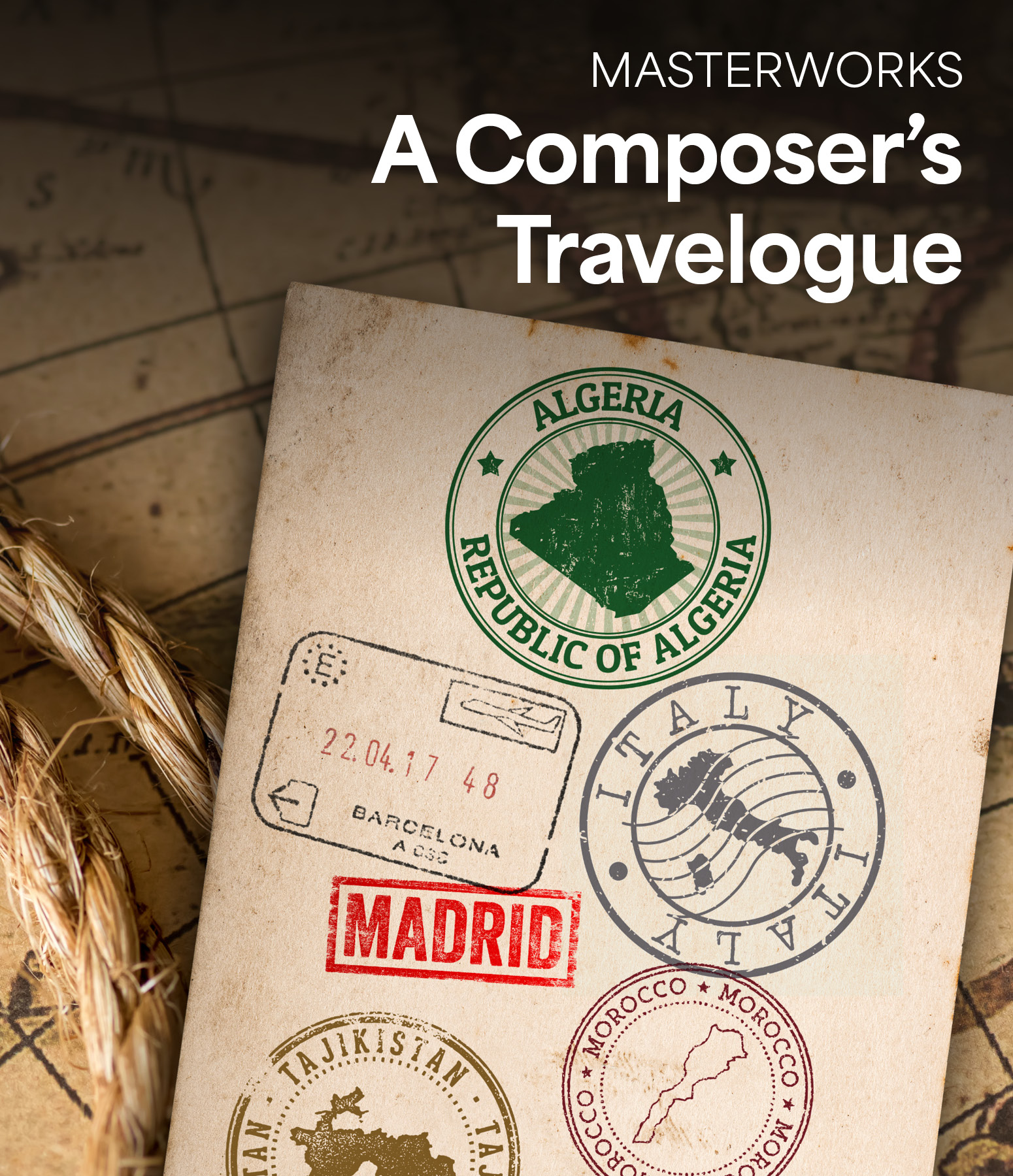
Pack your musical passport and join us for A Composer’s Travelogue, a whirlwind symphonic journey across continents and cultures. From the fiery dances of Spain to the twilight stillness of North Africa, from the sun-washed streets of Italy to the moonlit deserts of Central Asia, this program celebrates the way composers have captured the sound of places they visited, imagined, or longed for.
Ravel, Debussy, and Rimsky-Korsakov bring Spain to life through three completely different lenses — elegant, mysterious, and electrifying. Saint-Saëns gives us a dreamy Algerian sunset, while Ibert sails us through three vivid ports of call. After intermission, we arrive in Italy through Strauss and Tchaikovsky, drift eastward with Borodin, and finish with Gershwin’s irresistible Cuban Overture.
About the Composer
Maurice Ravel
Joseph Maurice Ravel (March 7, 1875 – December 28, 1937) was a French composer, pianist and conductor. He is often associated with impressionism along with his elder contemporary Claude Debussy, although both composers rejected the term. In the 1920s and 1930s Ravel was internationally regarded as France’s greatest living composer.
Read More ››Claude Debussy
Claude Debussy (22 August 1862 – 25 March 1918) was a French composer. He is sometimes seen as the first Impressionist composer, although he vigorously rejected the term. He was among the most influential composers of the late 19th and early 20th centuries. Born to a family of modest means and little cultural involvement, Debussy showed enough musical talent to be admitted at the age of ten to France’s leading music college, the Conservatoire de Paris. He originally studied the piano, but found his vocation in innovative composition, despite the disapproval of the Conservatoire’s conservative professors. He took many years to develop his mature style, and was nearly 40 when he achieved international fame in 1902 with the only opera he completed, Pelléas et Mélisande.
Read More ››Nikolai Rimsky-Korsakov
Nikolai Rimsky-Korsakov (1844–1908) was a Russian composer celebrated for his brilliant orchestration and imaginative use of folk themes. A naval officer turned composer, he infused his works with color, fantasy, and national spirit. His music often explored nature, legend, and the supernatural, creating vivid, timeless soundscapes that defined Russian musical identity.
Read More ››Camille Saint-Saëns
Camille Saint-Saëns (1835–1921) was a French composer, pianist, and organist celebrated for his brilliance, precision, and versatility. His works often explore themes of nature, mythology, and spirituality, blending classical balance with Romantic color.
Read More ››Jacques Ibert
Jacques Ibert (1890–1962) was a French composer known for his elegance, versatility, and independence of style. Trained at the Paris Conservatoire and winner of the Prix de Rome, he composed music marked by clarity, wit, and color. His works, including Escales and Divertissement, reveal vivid orchestration, rhythmic energy, and lyrical grace. Blending humor, refinement, and imagination, Ibert created music that captured both sophistication and charm, securing his place as one of France’s most distinctive 20th-century composers.
Read More ››Pyotr Ilyich Tchaikovsky
Composer Pyotr Ilyich Tchaikovsky was born on May 7, 1840, in Vyatka, Russia. His work was first publicly performed in 1865. In 1868, his First Symphony was well-received. In 1874, he established himself with Piano Concerto No.1 in B-flat Minor. Tchaikovsky resigned from the Moscow Conservatory in 1878, and spent the rest of his career composing yet more prolifically. He died in St. Petersburg on November 6, 1893.
Read More ››Alexander Borodin
Alexander Borodin (1833–1887) was a Russian composer, chemist, and key figure in shaping a national musical identity. Though science was his profession, his music revealed remarkable lyricism, color, and structure. Works like Prince Igor and In the Steppes of Central Asia show his gift for melody, vivid orchestration, and emotional depth, uniting intellect and artistry.
Read More ››George Gershwin
Born on September 26, 1898, in Brooklyn, New York, George Gershwin dropped out of school and began playing piano professionally at age 15. Within a few years, he was one of the most sought after musicians in America. A composer of jazz, opera and popular songs for stage and screen, many of his works are now standards.
Read More ››